Straightener Temperature Chart by Hair Type
ALFREDO DE BENEDICTIS FOUNDER | HAIRSTYLIST

Alfredo De Benedictis is an Italian-British hair stylist and salon owner with over 40 years of experience. Since 1989, his passion for innovation has led him to create groundbreaking hair tools that minimize stress on the hair while delivering flawless results. From the iconic Rootpermer and Wellformer of the ’90s to the global hit Babyliss Curl Secret, Alfredo’s mission remains the same—developing tools that protect hair health without compromising style.
Key Takeaways:
- Different hair types and conditions require varying temperatures.
- Start ‘low and slow’ for best results.
- Sectioning, consistent motion, and cooling are essential for smooth, lasting curls.
- Excessive heat can significantly damage your hair.
- Tension is another culprit of heat damage.
- The KEEO Genius Pro+ is a gentler straightener for all hair types.
Table of Contents:
- Introduction
- Straightener temperature chart (by hair type and condition)
- How to match your hair type & condition
- Why the “lowest effective heat” works
- Signs your temp is too high
- The low-damage straightening method
- Troubleshooting common issues
- What to do if your hair is coloured, grey, thinning, or already damaged
- How KEEO Can Help
- FAQs
The best temperature for heat styling will depend on your hair type, but the golden rule is ‘low and slow’
For severely damaged hair, start at 130–160°C. Thick or coarse hair can withstand up to 220°C.
Knowing your hair type will help you style it more safely and take better care of it. With that in mind, we’ve created a quick-look chart to partner with our Heat & Tension Quiz.
How to Match Your Hair Type & Condition
- There are quick tests to determine the density and condition of your hair.
- Both matter more than age when finding your ideal temperature.
Product build-up and poor sectioning often lead us to use unnecessarily high heat because we feel the straighteners aren’t working. Always clean your straighteners before or after use, depending on the condition and frequency of use. Proper sectioning is also essential to ensure the best results from your heated styling tools.
Why the “lowest effective heat” works
We always recommend starting at the lowest heat setting and working your way up if necessary. This is because the higher the heat, the higher the risk of damage.
Applying intense heat to your hair can dry it out and increase the risk of breakage. It can also make your hair rough and frizzy - the opposite of the sleek smoothness you are trying to achieve.
We tend to jump straight to turning up the heat if we feel our straighteners aren’t working. But there could be another issue.
For example, if you need more than three passes to straighten your hair, you probably haven’t prepped or sectioned it properly.
Signs your temp is too high
Here are a few signs you need to reduce the temperature:
- The sound of hair sizzling - could also mean hair is wet.
- Smoke is coming from the tool.
- The smell of smoke or burning.
- Snapping and breakage.
- Crunchy or split ends.
- Hair feels coarse or rough.
- Flyaways increase.
- Frizz.
The low-damage straightening method
To straighten your hair on a lower heat:
- Ensure hair is moisturised with hydrating shampoos and conditioners.
- Fully dry hair with a blowdryer or allow hair to air dry fully.
- Section your hair into sections around the width of the plates.
- Brush the section through and apply heat protectant.
- Slowly glide the straighteners through your hair - one pass per section.
- Let hair cool before re-touching.
- Use a finishing spray or serum to keep her smooth and shiny.
Troubleshooting Common Issues:
- Still frizzy: humidity/product order/too-large sections.
- Snagging: plate build-up, damaged ends, too much product film, unbrushed hair.
- Flat hair: temp too high or too many passes.
What to do if your hair is coloured, grey, thinning, or already damaged:
Coloured/Bleached
If your hair is coloured, it may be more porous, meaning it is more susceptible to drying frizz and cuticle damage.
- Try a leave-in moisturising treatment the night before you style.
- Start at a low temperature.
- Use a good heat protectant.
- Avoid repeated passes.
Grey/Wiry
Grey hair can be fine in density but coarse or wiry in texture. This makes it more difficult to correctly judge the temperature you need.
- Prep your hair with a clarifying/silver shampoo every two to three weeks.
- Start at a mid-low temperature.
- Use products designed to smooth.
- Have realistic expectations - ‘glass hair’ on a high heat doesn’t work on coarse grey. hair.
Fine/Thinning
Fine/thinning hair needs extra care when heat styling.
- Use a lower temperature.
- Reduce tension - don’t clamp, glide.
- Focus on root lift and shape rather than an ultra-smooth finish.
Already Damaged
If your hair is already damaged, be careful not to damage it further with intense heat.
- Focus on repairing your hair before styling.
- Intensive conditioning and bond repair products can help.
- Get a trim to eliminate split ends and encourage healthy regrowth.
- Reintroduce heat slowly at a low setting and less frequently than you would usually. style.
- Alternate heat and other methods of styling, including protective hairstyles.
How KEEO Can Help
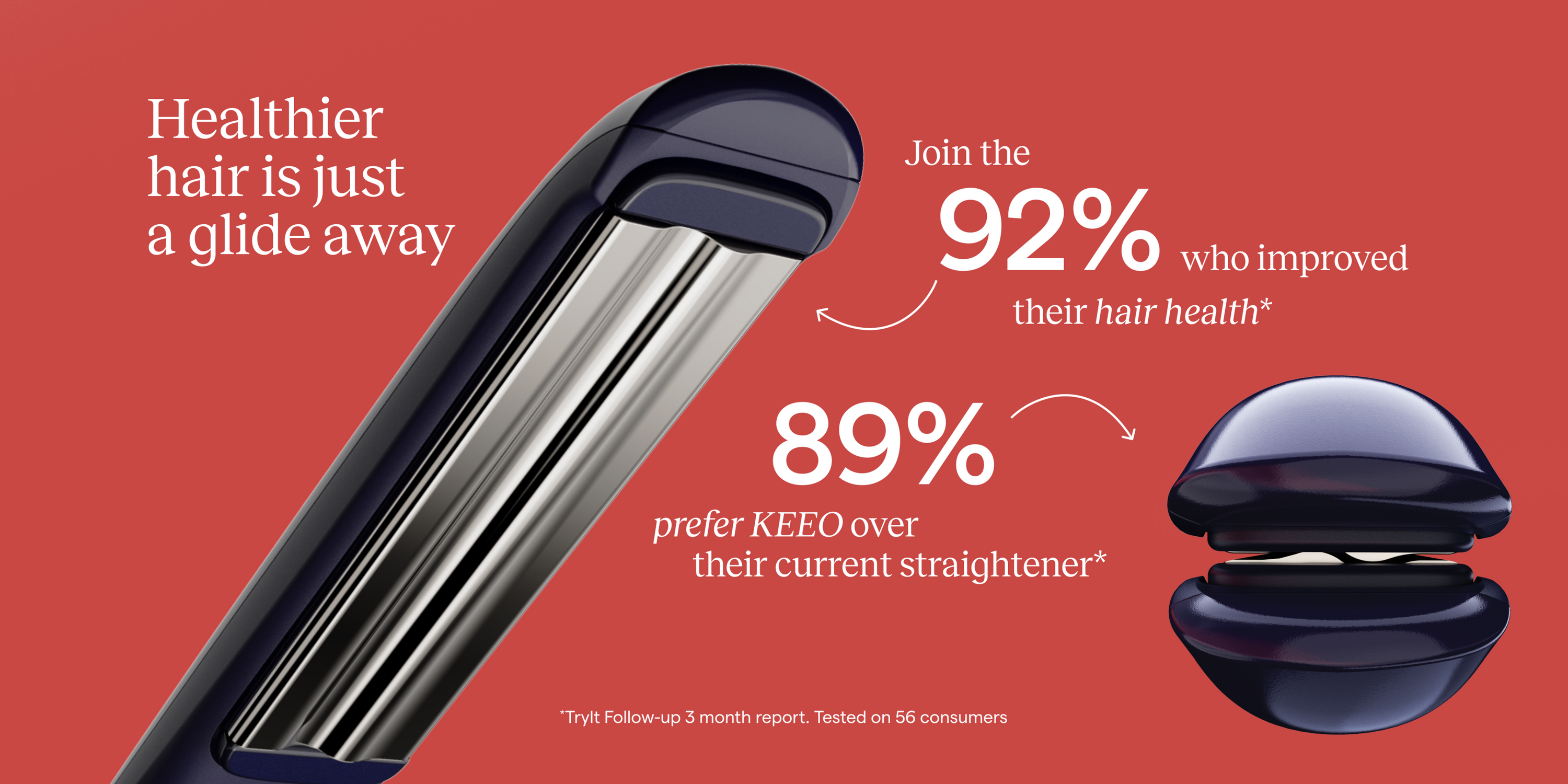
The KEEO Genius Pro+ is designed to care for your hair while it styles. Hair looks and feels healthier after only 30 days. This might sound like a big claim, but we’ve got the science to back it up.
- Our patented smart glide plates don’t clamp or snag your hair.
- Our custom tension control offers up to 70% less stress on your hair.
- The unusual shape of our Smart-Glide plates, with air gap technology, releases heat evenly.
Trichologist Kate Holden explains:
“Traditional styling tools can exert intense mechanical tension and high heat, both of which can aggravate fragile strands and accelerate breakage. What’s unique about KEEO is that it gives users control — not just over temperature, but over tension, too. The contoured plates glide through the hair, reducing stress on the fibre by up to 70%. For those with vulnerable, hormonally affected, or post-shedding hair, this kind of technology offers a gentler, more considered way to style — without compromising on results.
“As a hair health expert, I can tell that the Genius Pro+ wasn’t just made to style hair - it was made to protect it too.”
Conclusion
Using the correct temperature and tension for your hair type and condition will minimise damage and help you achieve the healthy, beautiful and perfectly styled hair you crave.
Remember to dry and prep hair, use a heat protectant, and properly section before styling.
No matter your hair type, the KEEO Genius Pro+ is gentler, for effortless style without stress and damage.
FAQs
If you aren’t sure about your hair type, start with the lowest setting and work your way up, if necessary. You can find out more about hair types and curl patterns in our previous blog.
We don’t recommend doing one pass at a high heat. It is healthier for your hair to do a few slow passes at a lower temperature than it is to do one fast pass at a high heat.
There are a few reasons why your hair may still feel frizzy after straightening:
- Heat damage to the outer cuticle allows moisture to escape, leading to frizz.
- High-porous hair is more prone to frizz than other hair types due to lifted cuticles.
- The wrong products, or product build-up, can leave hair dry, damaged and frizzy.
- Humidity can penetrate the hair shaft, causing frizz.
To combat frizz after straightening:
- Use a clarifying shampoo around every two weeks to remove build-up.
- Never skip a trim - every 4-12 weeks ,depending on the cut and condition of your hair.
- Hydrate and moisturise your hair to keep it soft and healthy before styling.
- Invest in a good heat protectant.
- Use a lightweight serum after straightening to seal the cuticle and block humidity.
Your straightener plates should be gently cleaned regularly, depending on how often you use the device and which products you use with it.
A quick frequency guide:
- Daily Use: wipe down the plates with a soft microfibre cloth after each use.
- Weekly Use: Once a fortnight.
- Occasional Use: once a month.
- Multiple Users: e.g., commercial use - clean after every client.
Make sure the straightener has been switched off and is mostly cool (but not cold) before cleaning.
Dirty plates can increase the risk of damaging your hair because:
- Product build-up can make the plates sticky, causing hair to snag and break.
- The heat won’t penetrate the residue, so you will have to use more passes - leading to more damage.
- The residue can transfer to your hair, leaving it looking greasy and unhealthy.
Dirty plates may harbour bacteria that can irritate your scalp.
Both are important. Heat protectant provides a barrier between the hair and the heat. This thin protective film prevents the heat from penetrating the hair shaft too quickly and helps distribute the heat evenly. It also locks moisture into the hair cuticle to prevent the heat from drying out your hair.
However, the hotter the temperature, the faster the heat will penetrate. If your hair is wet or severely damaged, it can ‘fry’ almost instantly.
Stay up-to-date
Blog posts
Best Hair Straighteners for Frizzy Hair

Best Hair Straighteners for Fine Hair (Without Damage)